
From Books to Classes to Beyond
Welcome! This resource page offers a new model of communication to assist our nuns and monasteries in ongoing formation. It is our Association’s response to Pope Francis’ call for the renewal of all contemplative nuns as expressed in Cor Orans and Vultum Dei Quaerere: “In order to ensure adequate ongoing formation, federations are to promote cooperation between monasteries through the exchange of formational materials and the use of digital means of communication, always exercising due discretion.” Vultum Dei Quaerere, Art. 3.2
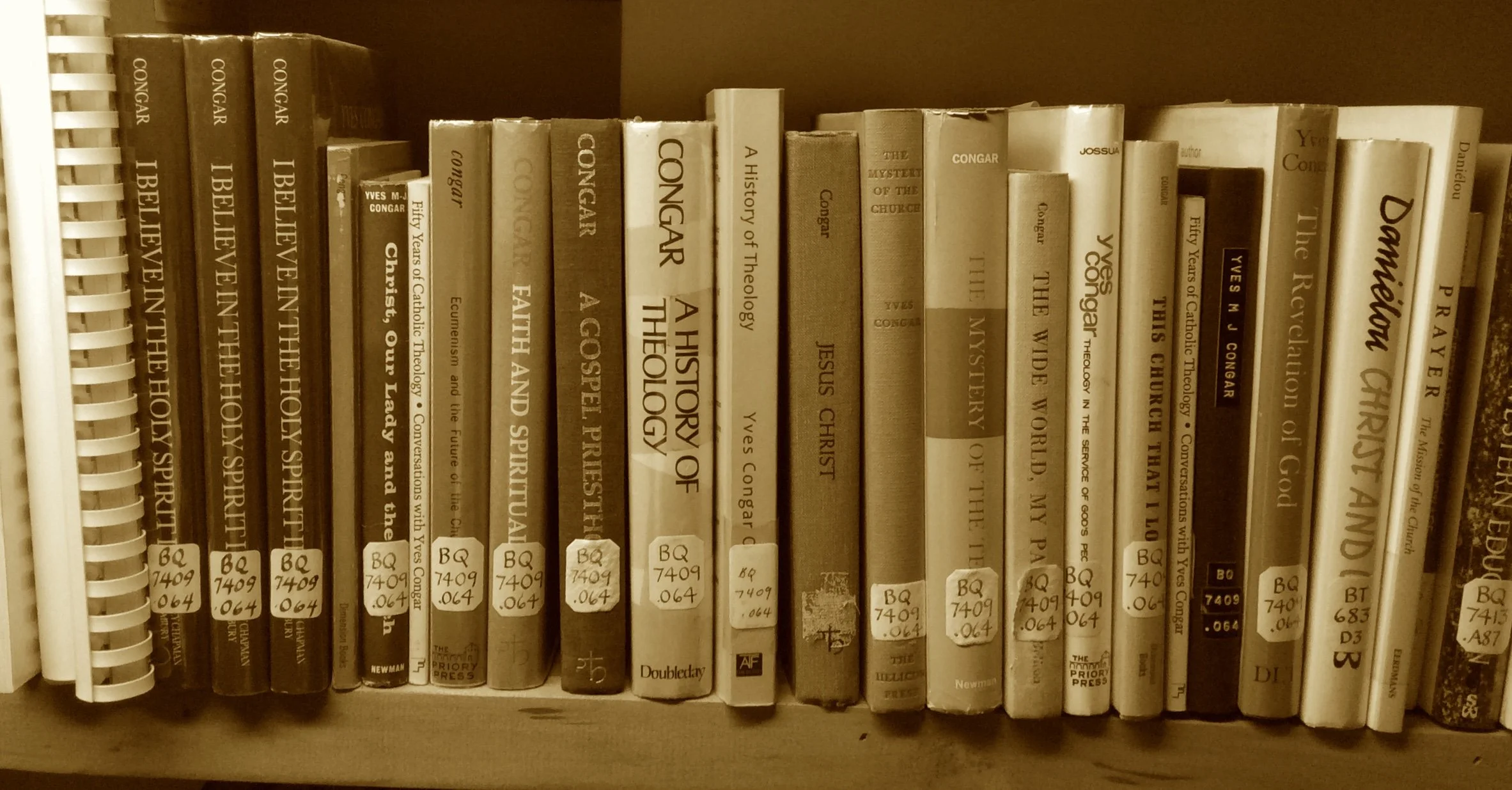
Book Recommendations
Many of us who have visited other monasteries find ourselves naturally (as good Dominicans) exploring their libraries, and often return home with a wish list of books to add to our own libraries. This space will identify books useful for study.
Fr. Andrew Hofer, OP's The Power of Patristic Preaching: The Word in Our Flesh (The Catholic University of America Press, 2023).
Abuses in the Religious Life and the Path to Healing (Sophia Institute Press, 2020) by Dom Dysmas de Lassus,O. Cart., superior general of the Carthusians.
The Divine Office Hymnal (GIA, 2023). Has your community adopted the hymnal yet?
A fascinating story of four women philosophers…
An overdue translation of a foundational resource book on the liturgy (originally published in 1923) by the great Guardini…
Liturgy and Liturgical Formation by Romano Guardini
Articles of Interest
"Studiositas: The Virtue of Attention” (Professor Gregory M. Reichberg)
During my month’s stay assisting the nuns at Lunden Kloster, Oslo, Norway, I had the opportunity to meet with Professor Eric Reichberg, Research Professor at the Peace Research Institute Oslo (PRIO) and consultor to the Holy See's Dicastery for Promoting Integral Human Development.
Our conversation turned to St. Thomas Aquinas and the professor shared his excellent article, which addresses the habitus of study, so integral to our formation as Dominican Nuns.
Monastery Lectures
Here we will feature recorded lectures shared by our monasteries and posted on the Association's YouTube channel. Bro. Ignatius Perkins, OP, will be giving lectures on Catholic Healthcare Ethics this summer at the Summit monastery. It is my hope that this will be our debut lecture. Stay tuned!
Although shared Zoom lectures among monasteries remain an option, the differences in time zones and schedules have made the logistics of participation a real challenge. Recorded lectures seem to be a more efficient (and less expensive) way for monasteries to share lectures.
Online Lectures
Gregorian Chant Academy offers a wide range of classes from mini to master on Gregorian Chant at one's own schedule (ideal for us busy nuns!).
For Advent refectory (or individual) listening, we highly recommend "Conditor Alme Siderum: A Traditional Catholic Hymn for Advent," a talk given by Dr. John Pepin for The Institute of Catholic Culture. The Institute offers a wide variety of lectures, courses, and reflections (all free).
The Pillar describes itself as "a Catholic media project focused on smart, faithful, and serious journalism, from committed and informed Catholics who love the Church." With a balanced approach to covering Catholic news, it is definitely worth exploring and subscribing to.
The Augustine Blog: Theology for Transitional Times "publishes short pieces from a wide range of authors who are engaged with the writings and legacy of St. Augustine. Experimenting with a variety of public-facing forms – such as reflections, essays, conversations, interviews, book reviews, etc. – these pieces may also adopt any number of postures towards Augustine and his wider influence."
History of Medieval Philosophy This course (given at the Dominican School of Philosophy and Theology in Spring 2021) focuses principally on the development of Christian philosophical theology, emphasizing: Patristic Roots (to 1100), Scholastic Synthesis (1200 to 1325), and Nominalist Critique (1325-1450). Attention is also be given to the reception of Greek, Arab and Jewish learning by the medieval west. Anselm of Canterbury, Bonaventure, Thomas Aquinas, Duns Scotus, and William of Occam receive special attention.
About the Instructor: Very Rev. Augustine Thompson, O.P. is a Catholic priest of the Order of Preachers who is president of the Pontifical Institute for Medieval Studies (PIMS), an institute for advanced studies in the intellectual and material cultures of the Middle Ages in Toronto, Canada. Father Thompson has had a distinguished academic career holding senior teaching positions at the University of Oregon and the University of Virginia (Charlottesville), as well as the Dominican School of Philosophy and Theology in Berkeley, California. A well-published medieval historian, his many books and articles include, most notably, Francis of Assisi: A New Biography (Cornell University Press, 2012) and Cities of God: The Religion of the Italian Communes, 1125–1325 (Pennsylvania State University Press, 2005). His latest book is Dominican Brothers: Conversi, Lay, and Cooperator Friars (New Priory Press, 2017).
Professional training is vital to the expression of our liturgical life in the monastery. The Catholic Institute of Sacred Music at St. Patrick's Seminary, Menlo Park, CA, offers in-person summer courses for church musicians.
Online/Recorded Lectures and Courses
Notable among the free online lectures available through YouTube are those offered on The Thomistic Institute's Channel, which I know several of our monasteries have already used. We could select those which may be of particular interest and include them on the Association’s YouTube channel library.
Online/In-Person Classes
Professional training is also vital to our monastic life. The Catholic Institute of Sacred Music at St. Patrick's Seminary, Menlo Park, CA, is offering free tuition for their Summer 2023 courses.
Recorded Lectures
The Great Courses is a fantastic (and financially reasonable) resource for quality lectures. The Summit monastery has just finished listening to Biblical Wisdom Literature (Fr. Joseph Koterski, SJ) in our refectory.
“The purpose of ongoing formation is to nourish and preserve fidelity , both of the individual nun and of the community, and to bring to completion what was begun in initial formation, so that the consecrated person can express fully her own gift in the Church, according to a specific charism.”
Cor Orans, 233